Learn / Tarot / Cards / Major Arcana / Wheel of Fortune
Wheel of Fortune
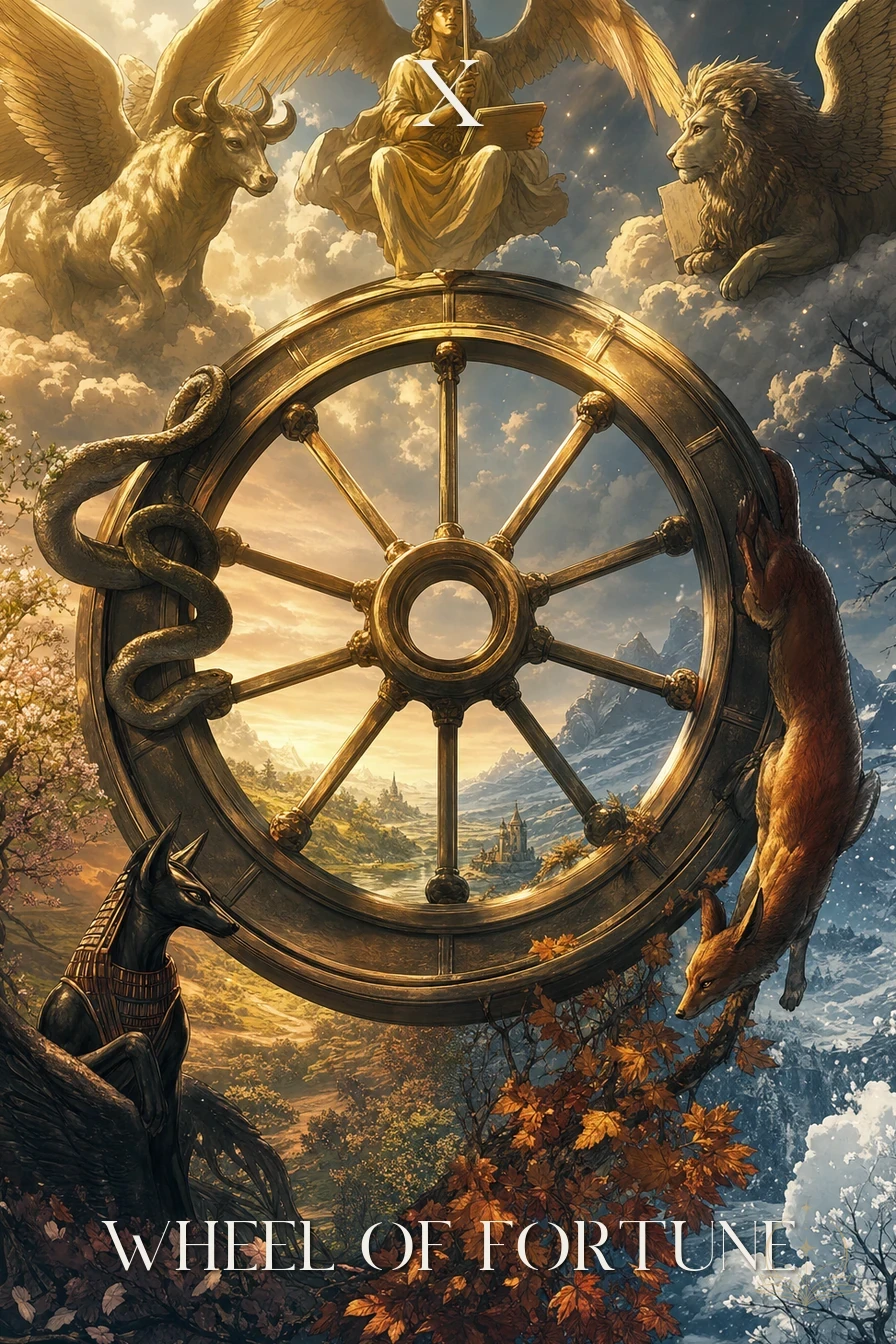
The Wheel of Fortune is the card of cycles, fate, and the impersonal movement of circumstances that no individual controls. Jupiter's expansive influence lends it a quality of opportunity and abundance when the wheel is ascending, but the card's deeper teaching is the impartiality of the turn itself: no position on the wheel is permanent. Traditionally it governs luck — good and bad — turning points, and the recognition that much of what feels like destiny is actually pattern. The appearance of the Wheel tends to signal change regardless of direction, and an invitation to locate one's center rather than cling to a position that will not hold.
Imagery
The Wheel of Fortune is often depicted as a large wheel — sometimes inscribed with alchemical or astrological symbols — attended by figures ascending and descending its rim, while a sphinx or other stable figure sits atop it unmoved. Clouds at the corners commonly bear the four fixed signs of the zodiac, suggesting the forces that frame and witness the turning.
Reversed
Reversed, the Wheel of Fortune emphasizes the harder face of the turn. It can mark a downswing — a run of misfortune, a reversal of circumstance, the period when the impersonal movement of events runs against rather than with the person caught in it. More often the reversal points to resistance: the attempt to cling to a position the wheel is determined to move, the refusal to accept that no place on the rim is permanent. Jupiter's expansiveness, inverted, shrinks into a sense of being stuck or singled out by fate. Traditionally the card reversed also describes a cycle repeating because its lesson went unlearned — the same situation arriving again in new dress — and asks whether one is locating one's center, as the upright card counsels, or fighting a turn that will complete itself regardless.
A reference, not a reading. This is the card on its own… a reading reads how it falls with the others.