Learn / Tarot / Cards / Major Arcana / The Hierophant
The Hierophant
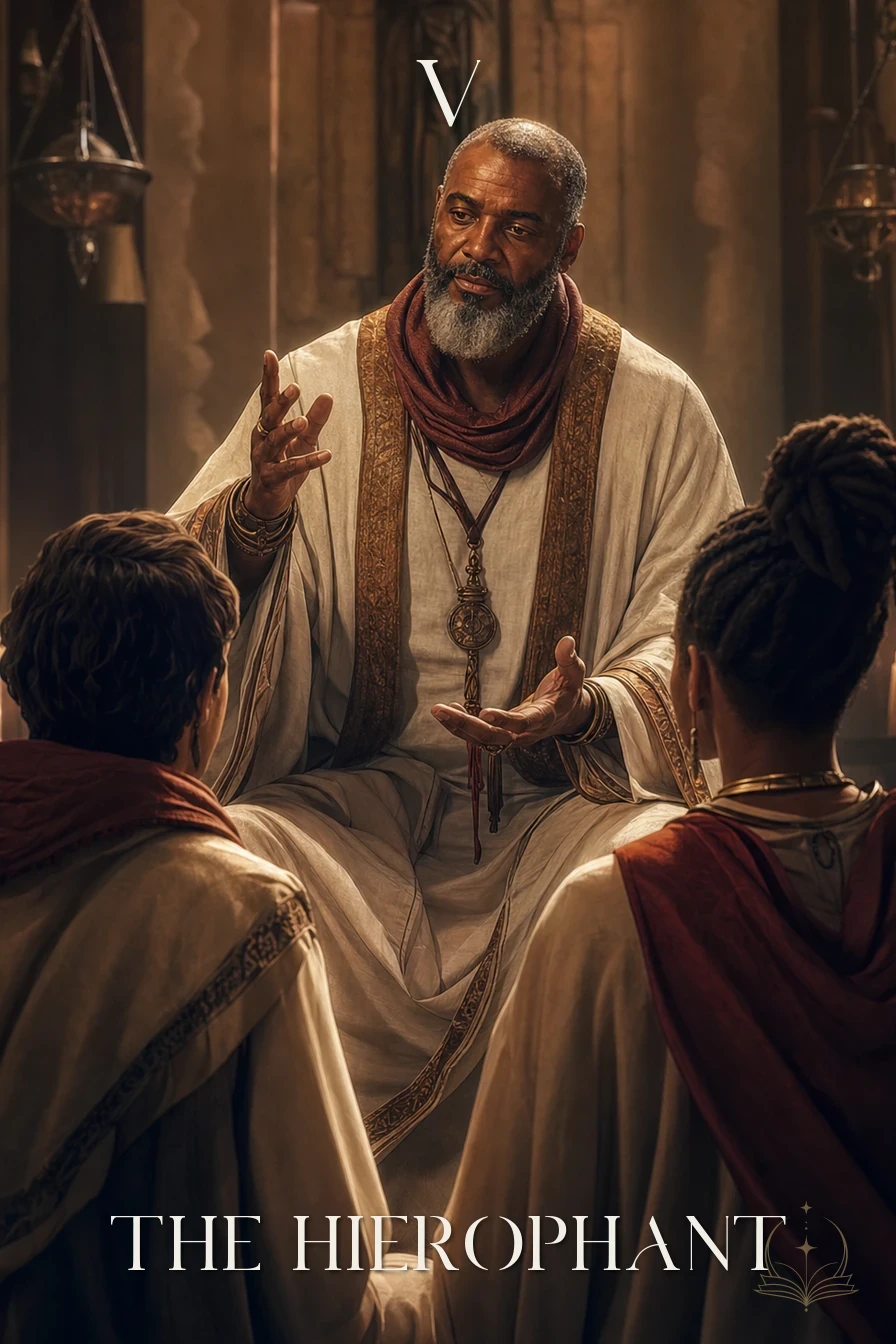
The Hierophant is the card of tradition, orthodoxy, and the organized transmission of knowledge and belief across generations. Where the High Priestess holds esoteric wisdom in private, the Hierophant speaks the established doctrine publicly; his domain is the institution — church, school, guild, cultural norm — and the role of ritual in making meaning communal. Taurus grounds him: there is longevity here, stability, a preference for the tested over the novel. The card is neither flatly conservative nor naively orthodox — it asks whether the tradition in question actually carries wisdom, or whether form has outlasted the living meaning it once housed.
Imagery
The Hierophant is often depicted as a crowned ecclesiastical figure seated on a throne between two pillars, his hand raised in a gesture of benediction or teaching. Two supplicants are commonly shown kneeling before him, and he typically holds a triple-cross scepter — all marks of a figure who mediates between divine authority and a gathered community.
Reversed
Reversed, the Hierophant marks a departure from established doctrine. This can be liberating: the recognition that a tradition, institution, or inherited belief no longer carries living meaning, and the willingness to seek one's own understanding rather than accept the received one. It is the card of the freethinker, the reformer, the person who declines to kneel. But the reversal carries a shadow too — empty conformity, dogma clung to long after its spirit has departed, or rebellion for its own sake that discards genuine wisdom along with dead form. Traditionally it asks whether one is breaking from convention because it is false or merely because it is convention, and whether the authority being rejected was hollow or simply inconvenient.
A reference, not a reading. This is the card on its own… a reading reads how it falls with the others.