
Learn / Astrology / Planets / Mercury in Astrology
Mercury in Astrology
Mercury is the principle of mind in motion: how a chart thinks, speaks, learns, and carries meaning from one place to another. It governs language and exchange, the quick traffic of perception and reason, and it rules two signs — Gemini, where it is curious and connective, and Virgo, where it turns analytic and precise.
Overrun, Mercury scatters into chatter, nervous overthinking, or cleverness with nothing beneath it. Well-tuned, it is the clear, agile intelligence that translates the world into words and makes understanding possible.
Mercury is the planet of the mind. It governs how you think, perceive, learn, and communicate — the whole machinery of taking the world in, making sense of it, and handing it back out in words. If the Sun is the self and the Moon is the feeling, Mercury is the narrator: the voice in your head and the voice in your mouth, forever turning experience into language.
It works in three motions. First perception — how you notice, what you register, the kind of information you're wired to catch. Then cognition — how you sort, connect, and reason with it. Then expression — how you put it back into the world as speech, writing, gesture, exchange. Your Mercury describes the signature of all three: whether you think fast or deep, in pictures or in lists, out loud or only after long silence. It's your learning style and your talking style, the wiring of your attention.
Mercury also names and sorts. The mind can't hold the world whole, so it divides experience into words, categories, symbols, and systems. This is the planet of lists, labels, measurements, definitions, and all the small distinctions that let thought become usable. Its gift is precision. Its danger is mistaking the name of a thing for the thing itself.
And it is, importantly, morally neutral. Mercury is a tool, not a conscience. It's as good at rationalizing as reasoning, as fluent in the convenient lie as the hard truth — which is the first hint that the mind and the trickster are closer relations than we like to admit.
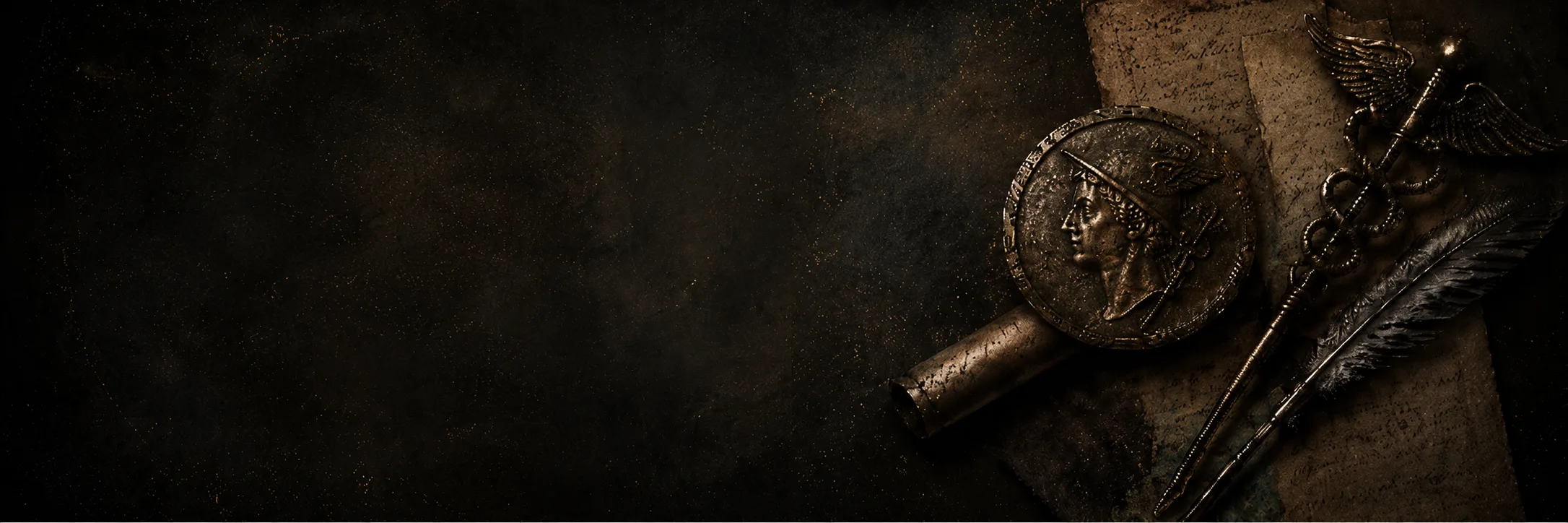
The god the planet is named for makes this explicit. Mercury is the Roman Hermes: messenger of the gods, and also their most gifted liar. On the day he was born, Hermes climbed out of his cradle, stole Apollo's sacred cattle, and drove them backwards so their tracks pointed the wrong way — then invented the lyre from a tortoise shell and charmed his furious brother into forgiving him with a song. Messenger, thief, inventor, negotiator, and smooth talker, all before his first nap. His name likely comes from herma, the roadside cairns that marked boundaries — which is the whole point. Hermes was the god who crossed every border: between gods and mortals, between cities, between the living and the dead. He was the psychopomp, the guide of souls into the underworld, moving across that last boundary as freely as he crossed every other.
That is the deep logic of Mercury, and it's why the messenger and the trickster are the same figure. Both are about crossing the gap. Communication is the act of getting something across a boundary — from my mind into yours — and anything that can carry a true message across that gap can carry a false one just as easily. The god of translators is also the god of liars, because translation and deception are the same skill pointed in different directions. Merchants and thieves both prayed to Hermes, and they weren't confused.
There's an older layer, too. The Egyptians had Thoth, the ibis-headed god of writing, measurement, and wisdom — the scribe who recorded the weighing of every soul's heart. When the Greek and Egyptian worlds met, Thoth and Hermes fused into a single legendary sage, Hermes Trismegistus, "thrice-great Hermes," credited as the source of the Hermetic texts, of alchemy, and of the maxim this whole art is built on: as above, so below. Which means the god of the thinking mind is also, by tradition, the patron of astrology itself. The planet that governs how you read is the one mythology hands the entire practice of reading the sky.
Mercury's nature is unusually changeable. Traditional astrologers called it convertible because it readily takes on the quality of whatever it joins — warm with the warm, cold with the cold. That's why it rules two very different signs. As ruler of Gemini it's the quick, curious, restless mind — collecting, connecting, chattering, delighting in the new. As ruler of Virgo it's the careful, discerning, analytical mind — sorting, refining, making things actually work. One mind reaches out; the other hones in. Most people run some private mixture of the two.
In your chart, Mercury's sign colors the style of your thinking and speech — blunt or diplomatic, literal or lateral, restless or methodical. Its house shows where your mind is most engaged, the arena of life you're forever gathering information about and talking through. At its best, a well-placed Mercury is clarity: curiosity, articulacy, the ability to learn quickly and explain plainly. Under strain it frays into its own excess — overthinking, anxiety, a mind that won't quiet, cleverness cut loose from wisdom, or the trickster's shadow of talking yourself and others into things that simply aren't true.
You've almost certainly met Mercury's most famous trick, too: retrograde. Because Mercury never wanders more than about 28° from the Sun, it periodically appears, from Earth, to slow, stop, and travel backward — three or four times a year. Read without the panic, it isn't a curse. It describes a stretch when Mercurial matters run less directly: plans double back, messages get crossed, decisions are revisited, and unfinished conversations return. That makes it genuinely useful for the re- words — review, revise, reconsider, reconnect — though not because the universe has booked you a productivity retreat. The messenger has turned around, and whatever was missed may come back with it.
And Mercury is never really solo. Because it clings so close to the Sun — never more than about 28° away — it usually sits in the same sign as your Sun or a neighboring one, and occasionally two signs off, quietly shaping how your whole identity gets expressed. In fact Mercury shapes how every planet speaks: it's the chart's interpreter, the one that puts the rest into words. Read alone it's just a thinking style. Read in context, it's the voice the whole chart talks through.
Which is, in a sense, exactly what AuLun is doing right now — a Mercurial act through and through: taking the silent geometry of a chart and turning it into language you can actually read. It reads your Mercury inside the whole pattern, never as an isolated label, and treats the mind it describes as something you can sharpen rather than a verdict you're stuck with.
Mercury is the part of you standing at the threshold, carrying meaning back and forth — between what you sense and what you understand, between your mind and everyone else's. Handle it well and it's the most useful god you've got. Just remember it will happily lie to you, too. That's the same gift, turned around.
Common questions
What does Mercury mean in astrology?
Mercury is the planet of the mind and communication — how you think, perceive, learn, and express yourself. It covers perception, reasoning, and speech: the way you take information in, make sense of it, and put it back out in words. Where the Moon is feeling and the Sun is identity, Mercury is thought.
What is your Mercury sign?
Your Mercury sign is the sign Mercury was in when you were born, and it describes how you think and communicate — your mental style, your learning style, your voice. Because Mercury never strays more than about 28° from the Sun, it's always close to your Sun sign — usually the same sign or a neighboring one, and occasionally two signs away.
What does Mercury rule in astrology?
Mercury rules both Gemini and Virgo, and is exalted in Virgo. Broadly it governs the mind, communication, language, learning, perception, short travel, and exchange of every kind — from conversation to commerce.
What is Mercury retrograde?
Mercury retrograde is the stretch, three or four times a year, when Mercury appears from Earth to move backward. It isn't a curse — traditionally it points to reversals, delays, and second thoughts: plans double back, messages get crossed, and old conversations return. That makes it a good time to slow down and revisit things — review, revise, reconsider, and double-check communication, travel, and tech.
Why is Mercury both the messenger and the trickster?
Because they're the same skill. Communication means carrying meaning across the gap between minds — and anything that can carry a true message can carry a false one just as easily. Hermes was patron of translators and thieves alike, which is why Mercury governs both honest clarity and clever deception.
Deeper reads
What Astrology Actually Is
Astrology isn't fortune-telling — it's a symbolic language for reading the shape of a life. Pattern, not fate, and never a cage. What it actually is, honestly.
By L. Caffelli · July 2026 →How a Natal Chart Works
A birth chart isn't a personality test. It's a map of the moment you arrived — every planet, in every sign, in every house, in relationship to every other.
By L. Caffelli · July 2026 →